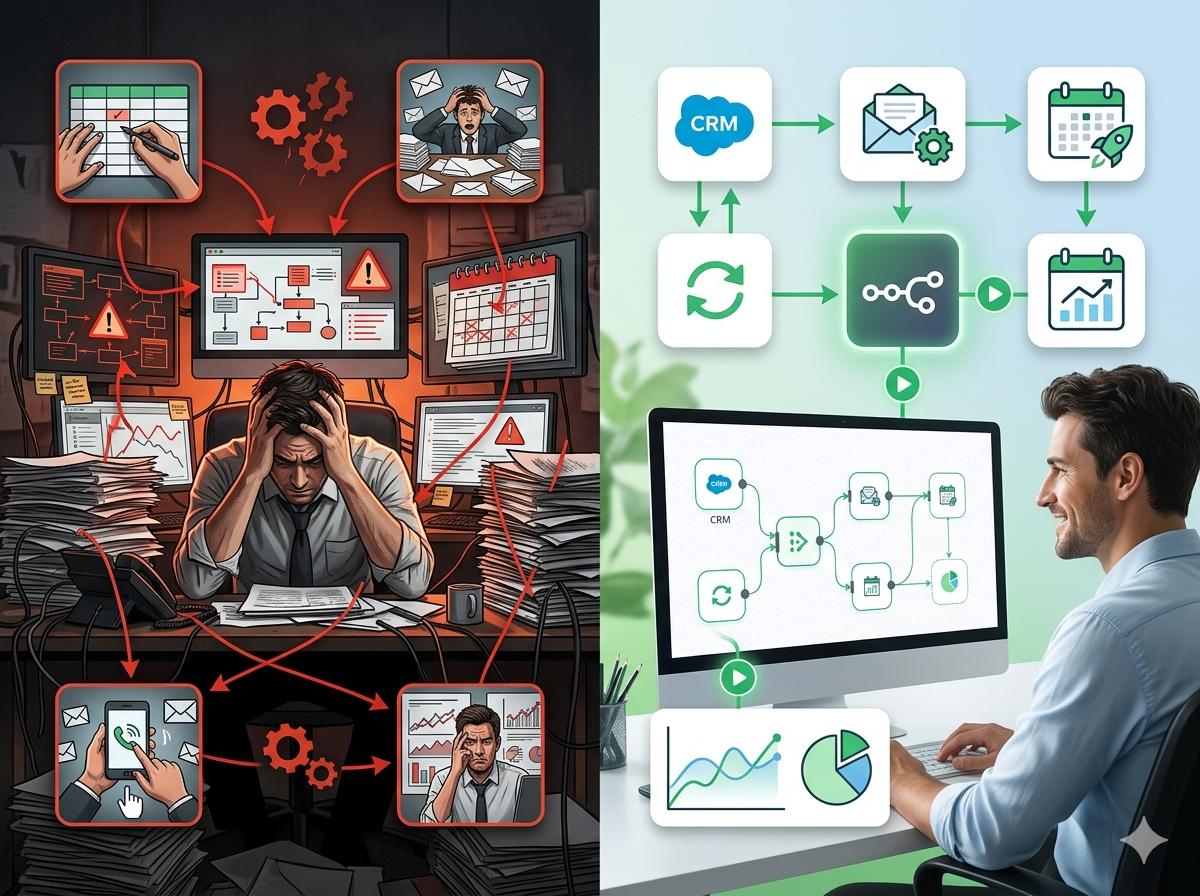
Online Course Automation: How E-Learning Entrepreneurs Are Reclaiming 20+ Hours a Week
Stop doing your e-learning admin by hand. Discover how online course automation tools can save 20+ hours a week and scale your education business.
You launched your online course to share your expertise and build a business around what you love. But somewhere between your third manual welcome email of the day, copy-pasting student progress updates into a spreadsheet, and chasing down failed payments at midnight, it stopped feeling like freedom. If you're running an e-learning business and still doing most of your backend work by hand, you're not alone, and more importantly, there's a better way. This guide breaks down exactly which workflows are silently stealing your time and how online course automation can give it all back.
Why E-Learning Businesses Are Drowning in Manual Work
Online education is one of the fastest-growing industries on the planet, projected to surpass $400 billion globally by 2026. Yet the majority of course creators, even those generating six figures, are operating like a one-person admin department. Every new student triggers a cascade of manual tasks: sending login credentials, adding them to a Facebook group, tagging them in an email list, scheduling a welcome call, and updating a student roster. Multiply that by dozens or hundreds of enrollments, and you've built yourself a very expensive job.
The problem isn't effort or dedication. The problem is that most course creators use five to ten different tools, a course platform like Teachable or Thinkific, a payment processor like Stripe, an email marketing tool like ConvertKit or ActiveCampaign, a CRM, a community platform, a Zoom scheduler, and none of them talk to each other automatically. Every gap between tools is a gap you're filling with your own time. That's where e-learning workflow automation comes in.
1. Student Onboarding and Welcome Sequences: Your First Impression on Autopilot
The onboarding experience is the single most important moment in a student's journey. Research consistently shows that students who feel welcomed and supported in the first 48 hours are dramatically more likely to complete a course and leave a positive review. Yet most course creators deliver a wildly inconsistent onboarding experience simply because they're doing it manually.
Here's what a typical manual onboarding looks like:
- Student pays and enrolls
- You get an email notification
- You (or a VA) manually send a welcome email
- You add them to your private community (Facebook Group, Circle, Slack)
- You add them to your CRM or spreadsheet
- You tag them in your email platform
- You schedule a welcome call or onboarding check-in
- You send course materials, bonus resources, or a getting-started guide
If you have five students enroll on a Tuesday while you're filming content, three of them might wait 12 hours for a welcome email. That's a trust-eroding delay that sets the wrong tone before a single lesson is watched.
With automated student onboarding, every single one of those steps happens instantly and consistently every time. The moment a student completes enrollment, an automation workflow fires: they receive a personalized welcome email within seconds, they're added to your community platform, they're tagged correctly in your email tool so they enter the right nurture sequence, and they're logged in your CRM. Zero manual effort. Perfect every time.
You can even trigger conditional logic, if a student enrolled in your premium tier, they automatically get a calendar link to book a one-on-one onboarding call. If they enrolled in the self-study version, they get a different sequence. This kind of personalization at scale is simply impossible to do manually when you're also trying to create content, run webinars, and grow your business.
2. Payment Processing and Enrollment Automation: Eliminate the Gaps Between Your Tools
Stripe, PayPal, ThriveCart, Teachable's native checkout, however you're taking payments, there's almost certainly a gap between money hitting your account and the right things happening downstream. This is one of the most common and costly pain points in the e-learning world.
Consider these real scenarios that course creators deal with regularly:
- A student pays through Stripe but your course platform doesn't auto-enroll them, so they email you confused and frustrated
- A payment fails and the student gets no notification, they just quietly lose access while you have no idea
- A student signs up for a payment plan and needs to be manually tracked for each installment
- A refund is processed but the student isn't removed from your community or email list for days
- You offer an early-bird discount and need to manually apply tags, grant bonuses, and update your accounting spreadsheet for every single purchase
Payment processing automation closes all of these gaps automatically. When a payment succeeds, the workflow triggers enrollment, community access, email tagging, and CRM updates simultaneously. When a payment fails, the student immediately gets a friendly recovery email with a link to update their card. When a refund is issued, access is revoked, they're removed from the active student community, and they're moved to a win-back sequence in your email tool. Every edge case handled, without you lifting a finger.
For course creators running payment plans, automation is an absolute game-changer. You can build workflows that track installment number, send reminder emails before each charge, celebrate when a student makes their final payment, and flag anyone who is falling behind, all automatically. What used to require a VA checking a spreadsheet daily becomes a set-it-and-forget-it system.
3. Progress Tracking, Drip Content, and Certificate Delivery: Keep Students Engaged and Completing
Course completion rates are notoriously low across the industry. The average completion rate for online courses sits somewhere between 3% and 15%. That's not just a student problem, it's a business problem. Low completion means fewer testimonials, fewer results-based case studies, fewer referrals, and fewer repeat buyers.
The good news is that a huge driver of low completion is simply a lack of timely, relevant communication. Students get busy. They forget. They hit a confusing module and don't know where to turn. With manual processes, you simply can't monitor 200 students individually and reach out at exactly the right moment. With automation, you can.
Here's what automated progress tracking and engagement looks like in practice:
- Drip content delivery: Rather than giving students access to everything at once (which is overwhelming), drip content automation unlocks new modules on a schedule or based on completion of previous lessons, keeping students progressing at a healthy pace.
- Inactivity triggers: If a student hasn't logged in for seven days, an automated check-in email fires, warm, encouraging, and specifically mentioning where they left off. Not a generic newsletter. A targeted nudge.
- Milestone celebrations: When a student completes their first module, finishes the halfway point, or submits their first assignment, an automated message celebrates the achievement. This is a small thing that has a massive impact on motivation and loyalty.
- Automated certificate delivery: When a student completes the final lesson or passes a quiz, the system automatically generates their completion certificate and emails it to them immediately, no waiting for you to manually run a report and send PDFs.
- Upsell triggers: When a student completes your course, they're at peak satisfaction. An automated sequence fires that celebrates their completion and introduces your next course, coaching program, or mastermind, exactly when they're most ready to buy again.
These workflows transform your course from a static product into a dynamic, responsive experience. Students feel seen and supported even when you're not actively in the platform, which directly translates to better outcomes, better reviews, and better business.
4. Marketing Automation and Re-Engagement Campaigns: Turn Cold Leads into Students
Marketing is where most course creators spend significant time and money, and where automation has some of the highest ROI. The typical course creator's marketing funnel is a patchwork of manually created sequences, ad-hoc email blasts, and forgotten leads who fell through the cracks months ago.
Let's look at where automation can make the biggest impact in your marketing:
Lead Magnet and Webinar Follow-Up
Someone downloads your free guide or registers for your webinar. They're warm. They're interested. But life gets in the way and they don't buy. Without automation, that lead often just… evaporates. With an automated follow-up sequence, they receive a precisely timed series of emails that provide value, address objections, and invite them to enroll, triggered automatically the moment they opted in, not whenever you have time to write the emails.
Abandoned Cart Recovery
Someone visits your checkout page and doesn't complete their purchase. This happens constantly and represents thousands of dollars in lost revenue for most course creators. An automated abandoned cart sequence, two or three emails over 48 hours, can recover a significant percentage of these lost sales entirely on autopilot.
Past Student Re-Engagement
Your past students are your warmest potential buyers for your next course. But are you systematically following up with them when you launch something new? Automation can tag students when they complete a course, track how long ago they purchased, and trigger a personalized re-engagement campaign when you launch your next product, targeting them differently than cold leads because they already know and trust you.
Review and Testimonial Requests
Most course creators leave a mountain of social proof on the table because they forget to ask for reviews, or feel awkward about it. An automated sequence that fires 14 days after course completion, asking for a testimonial and making it easy to leave one, can generate a steady stream of reviews without you ever having to ask personally.
When you combine all of these marketing automations, you're not just saving time, you're building a machine that consistently converts leads into students and students into repeat buyers, running 24/7 without your active involvement.
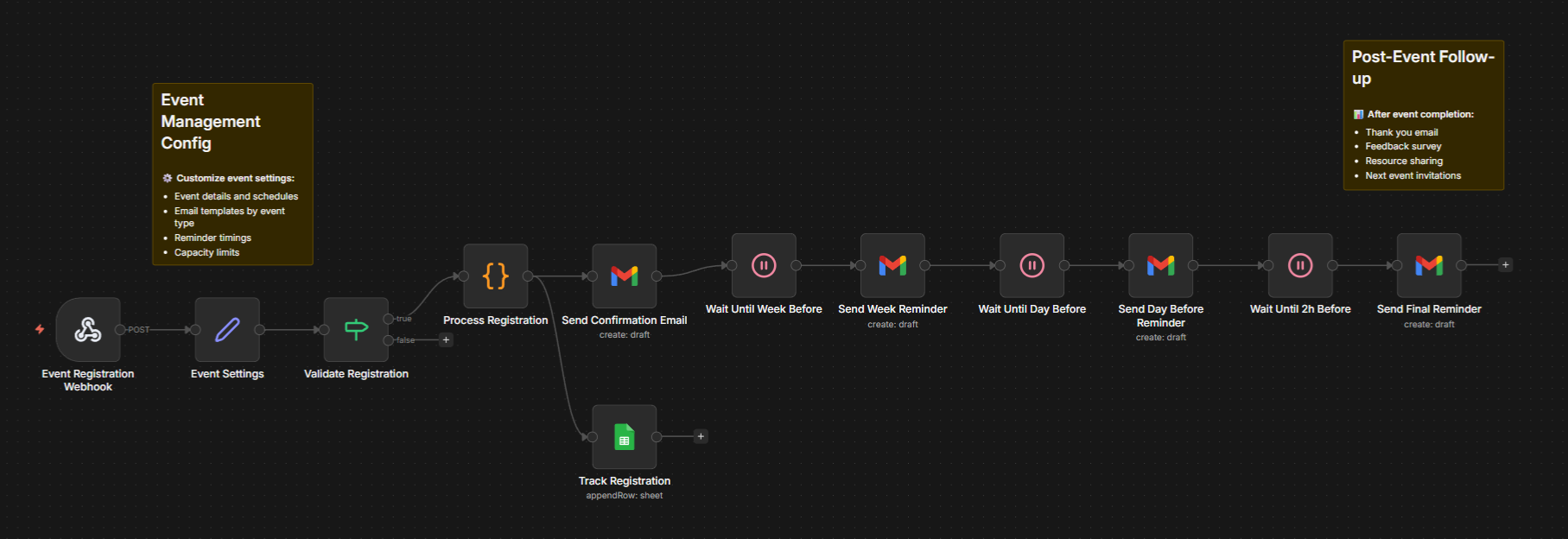
Ready to start automating your e-Learning workflows? Register for free for workflow templates, and a community of builders who are already using n8n to transform their operations. Your first automation is closer than you think.