Restaurant Workflow Automation: How Hospitality Businesses Can Save 10+ Hours a Week with Smart Automation Tools
Discover how restaurant workflow automation can save 10+ hours a week. Learn practical automation strategies for reservations, inventory, staff scheduling, and guest reviews.
Running a restaurant or hospitality business means juggling a hundred things at once, and most of them feel urgent. A no-show at table six, a supplier who's out of your signature ingredient, a stack of unanswered guest reviews, a schedule that fell apart because two people called in sick. If you've ever felt like you're constantly putting out fires instead of building a business, you're not alone. The good news? A large portion of the operational chaos that drains your time and your team's energy is automatable. This post breaks down the most time-consuming workflow bottlenecks in restaurants and hospitality, and shows you exactly how automation can solve them, without requiring a developer or a six-figure software budget.
The Hidden Cost of Manual Operations in Restaurants and Hotels
Before diving into solutions, it's worth naming the problem clearly. Most restaurant and hospitality operators know they're busy, but few have actually calculated how much time their teams spend on tasks that a computer could handle.
Consider a mid-size restaurant with 40 covers. Each week, a manager might spend:
- 3-4 hours manually reconciling reservation data across OpenTable, Google, and phone bookings
- 2-3 hours chasing suppliers via email or phone to confirm orders and check availability
- 1-2 hours copy-pasting staff availability into a scheduling spreadsheet
- 1-2 hours responding to or flagging online reviews across Google, Yelp, and TripAdvisor
- 2-3 hours generating end-of-week sales reports by hand from the POS system
That's potentially 10-14 hours per week spent on administrative work that doesn't require human judgment. At a fully-loaded labor cost of $25/hour for a manager, that's over $13,000 per year, just in management time, on tasks that could be automated.
For hotel and hospitality operations, the numbers scale even faster. A boutique hotel handling 50 rooms might add front desk coordination, housekeeping scheduling, and guest communication to that list, easily pushing manual admin work past 20 hours per week across the team.
This isn't just a time problem, it's a quality problem. When your team is buried in administrative tasks, they have less energy for what actually drives revenue: delivering exceptional guest experiences.
Reservation Management and Guest Communication: Automation That Pays Immediately
Reservation management is one of the highest-friction areas in restaurant and hotel operations, and one of the easiest to automate.
The problem: Guests book through multiple channels, your website, Google, OpenTable, Resy, phone, and walk-in. Each channel lives in its own system. A manager has to manually check all of them to get an accurate picture of the day's covers, which leads to double-bookings, missed reservations, and a front-of-house team that's never quite sure what's coming.
What automation solves:
- Unified reservation dashboard: Pull data from all booking channels into a single view, automatically updated in real time.
- Automated confirmation and reminder messages: When a reservation is created in OpenTable or your website form, trigger an automated SMS or email confirmation immediately, and a reminder 24 hours before.
- No-show follow-ups: If a guest doesn't show, automatically send a "We missed you" message with a re-booking link, recovering potential revenue without any manual effort.
- Special occasion triggers: If a reservation notes a birthday or anniversary, automatically alert the kitchen and floor staff, and trigger a personalized greeting from the team.
For hotels, the same logic applies to check-in and check-out workflows. Automated pre-arrival emails with room preferences, check-in instructions, and local recommendations can be triggered the moment a booking is confirmed, eliminating hours of manual guest correspondence.
Inventory Tracking and Supplier Orders: Ending the Monday Morning Scramble
Nothing derails a service like running out of a key ingredient mid-shift. Yet most restaurant operators are still managing inventory through a combination of manual counts, gut instinct, and reactive supplier calls.
The problem in detail:
- Stock levels are tracked in spreadsheets or not at all
- Reorder decisions depend on someone remembering to check
- Supplier communication happens over email, text, and phone calls, often with no record
- Waste isn't tracked systematically, so over-ordering continues
Automation use cases:
- Low-stock alerts: When a POS system or inventory tool registers that a product drops below a threshold (say, less than two cases of a house wine), automatically send an alert to the manager and a draft order email to the supplier.
- Scheduled order generation: Every Monday morning, automatically generate a purchase order based on the previous week's sales data and current stock levels, and send it to your supplier contacts without anyone touching a keyboard.
- Delivery confirmations: When a supplier confirms delivery, log it in your inventory system and alert the relevant team member, closing the loop without manual follow-up.
- Waste logging automation: Build a simple daily waste form that feeds into a Google Sheet. At the end of the week, automatically generate a waste report and send it to the kitchen manager.
These workflows alone can reduce food waste by 10-15% and eliminate several hours of manual purchasing work each week, a direct hit to your bottom line.
Staff Scheduling, Reviews, and Loyalty: Three More Automation Wins
Beyond reservations and inventory, three more operational areas offer significant automation potential for hospitality businesses.
Staff Scheduling
Building next week's rota is a notorious time sink. Most managers do it manually: collect availability via text, cross-reference with last week's hours, check compliance with labor rules, then communicate the final schedule, often through a group chat or posted notice board.
Automation can handle the data collection and communication layers. A weekly availability form sent automatically every Thursday collects responses in a structured format. That data can feed a scheduling tool or a simple spreadsheet, which then triggers an automated schedule distribution to staff via WhatsApp, SMS, or email every Sunday night, no manager intervention required.
Shift swap requests can also be automated: a staff member submits a swap request, the system checks for eligible coverage based on availability data, and the manager gets a one-click approval request, rather than a text message chain that runs into the evening.
Online Review Management
Online reviews on Google, TripAdvisor, and Yelp are a primary driver of new customer acquisition for restaurants and hotels, yet most operators respond to them inconsistently, or not at all.
Automation can't write your responses for you (well, AI can help with that), but it can eliminate the bottleneck of finding the reviews in the first place. Set up an automation that monitors your Google Business Profile, TripAdvisor listing, and Yelp page for new reviews and sends a daily digest to your manager's inbox, with the star rating, review text, and a direct link to respond. This alone can take the "review management" task from a scattered, forgotten chore to a consistent 15-minute daily practice.
You can go further: route 1-3 star reviews to a priority alert channel (Slack, SMS, or email) so they're addressed within the hour, while 4-5 star reviews go into a standard daily report.
Loyalty Programs and Repeat Guest Outreach
Guest retention is far more cost-effective than acquisition, but most restaurants don't have the systems to do it at scale. Loyalty program management, birthday offers, and re-engagement campaigns typically require either expensive CRM software or manual effort that never actually happens.
With automation, you can build a lightweight loyalty system from your existing tools. When a guest books through your website, capture their email and dining date. 90 days after their last visit, automatically send a "We'd love to see you again" email with a special offer. On their birthday month, send a personalized discount code. These aren't complicated campaigns, they're simple, time-triggered workflows that run without any ongoing management.
How n8n Powers Hospitality Automation Without Enterprise Pricing
Here's where most restaurant operators get stuck: the automation tools that solve these problems are either built for enterprise businesses (with enterprise price tags) or are so limited they can't connect the specific systems you're already using.
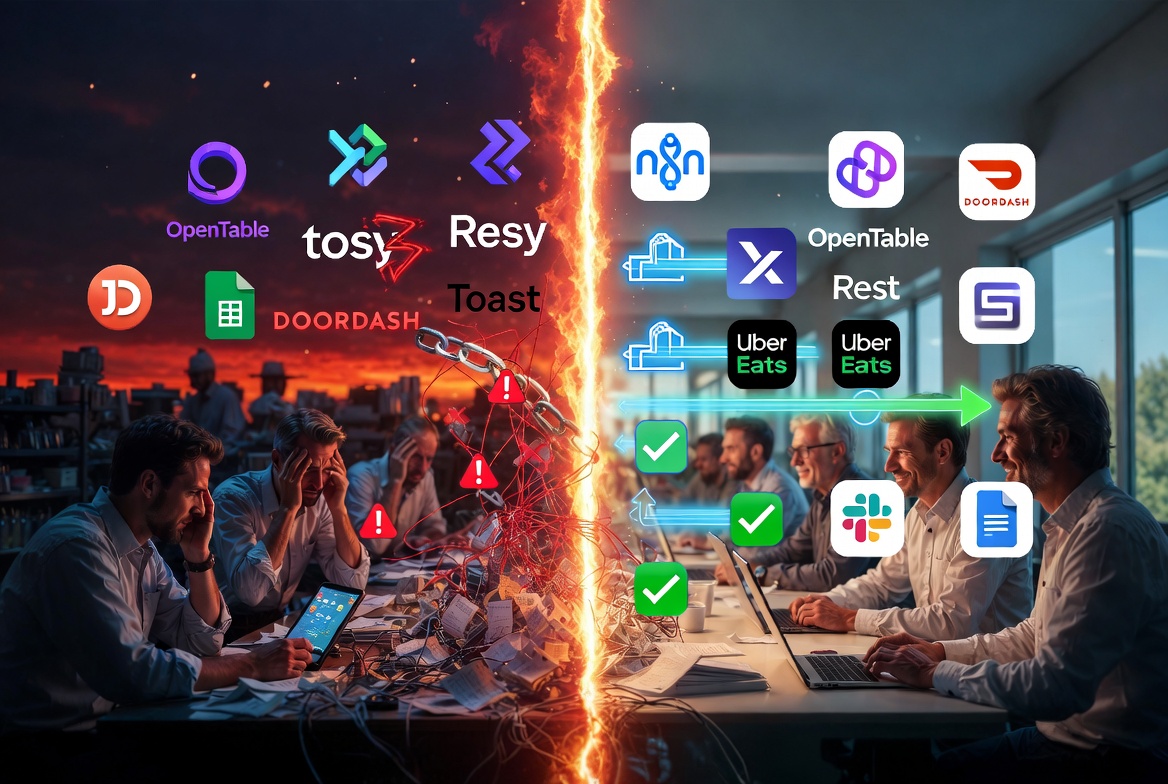
n8n is different. It's an open-source workflow automation platform that connects your existing tools, your POS, reservation system, Google Sheets, Slack, email, WhatsApp, and hundreds of other apps, through visual, no-code workflows. You don't need a developer, and you don't need to replace any of the tools your team already knows.
Here's what that looks like in practice for a restaurant or hospitality operator:
- Reservation sync: Connect OpenTable to Google Sheets and Slack. Every new reservation triggers a Slack message to the floor manager and logs the booking in a shared team sheet, in real time, automatically.
- Inventory alert workflow: Connect your inventory spreadsheet to your email. When a product quantity drops below a threshold you define, n8n automatically drafts and sends a reorder request to your supplier, no manual monitoring required.
- Review monitoring digest: n8n can poll your Google Business Profile API and send a formatted daily email summary of all new reviews, with star ratings and direct response links, every morning at 9am.
- Staff scheduling communication: Build a Typeform or Google Form for weekly availability collection. n8n processes the responses and sends personalized schedule confirmations to each team member via email or WhatsApp.
- Guest re-engagement: Connect your booking database to n8n. Set a trigger: if a guest hasn't dined in 90 days, automatically send a personalized email with a limited-time offer, pulling their name and last visit date from your records.
Because n8n is open source, you can self-host it on your own server for near-zero ongoing cost, or use the cloud version for a straightforward monthly fee. Either way, the pricing is a fraction of purpose-built hospitality software, and you're not locked into a rigid platform that doesn't fit your specific operation.
The flexibility is the point. Every restaurant and hotel has a unique mix of tools, workflows, and pain points. n8n lets you automate exactly what your business needs, not a generic template designed for a different kind of operation.
Where to Start: A Practical First Automation for Restaurant Operators
The most common mistake when getting started with automation is trying to do everything at once. Instead, pick one workflow that causes the most friction in your current week, and automate that first.
For most restaurant and hospitality operators, that's one of three things:
- Reservation confirmations and reminders, set up once, runs forever, immediately reduces no-shows
- Low-stock alerts, saves the mid-service scramble and prevents costly last-minute orders
- Weekly review digests, makes online reputation management a consistent habit instead of a chaotic afterthought
Once you've automated one workflow and seen how much time it returns, the second and third automations become obvious, and easier to build, because you'll understand the pattern.
The hospitality industry runs on margins that leave very little room for inefficiency. Every hour your team spends on manual administrative tasks is an hour not spent on the floor, in the kitchen, or with guests. Automation doesn't replace the human element that makes great hospitality, it clears the clutter so your team can focus on it.
Ready to reclaim 10+ hours a week?
Explore how n8n can connect your restaurant's tools and automate your most repetitive workflows. Register now to get started, no developer required, no long-term contract, and a free tier to try it with zero risk.