Stop Fighting Your Own Workflows: A Logistics Manager's Guide to Supply Chain Automation
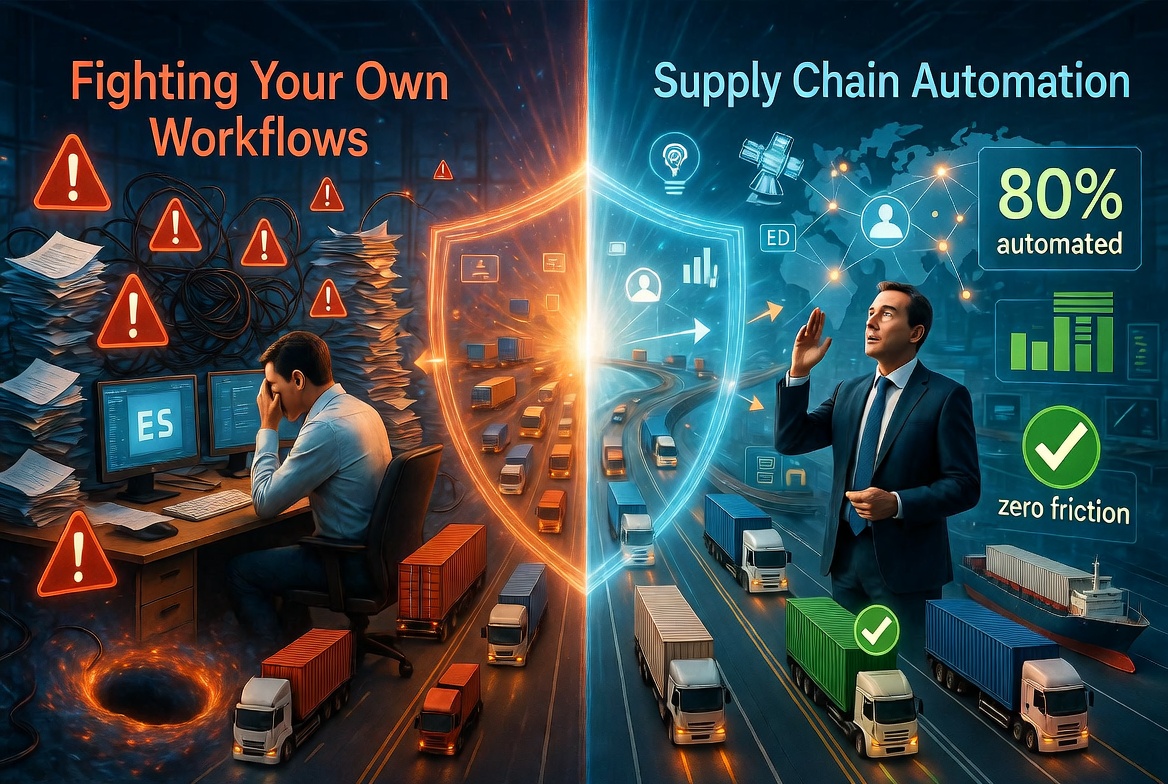
Learn how logistics workflow automation can eliminate manual document processing, slow EDI onboarding, and costly freight billing delays. See how n8n makes it real.
If you manage freight operations, run a 3PL, or broker loads for a living, you already know the feeling. It's 4:45 PM on a Friday, a carrier just sent a detention invoice that doesn't match your records, a customer is calling for a shipment update you don't have, and somewhere in your inbox there are three BOLs waiting to be manually entered into your TMS. This is not a technology problem. It's a workflow problem, and it's costing your business more than you think.
Logistics has always been operationally complex, but complexity has accelerated faster than most operations teams can absorb. Carrier networks, customer portals, EDI requirements, customs documentation, invoice reconciliation, every touchpoint adds friction, and friction compounds. The good news is that logistics workflow automation has matured to the point where a small operations team can automate processes that used to require a dedicated IT department. The bad news is that most logistics companies don't know where to start, or they assume the cost and complexity are out of reach.
This post is written for operations managers, freight brokers, and 3PL operators who are drowning in manual work and need a clear, honest look at what automation can do, and how to get there without a six-figure implementation budget.
The Hidden Cost of Manual Document Processing in Freight Operations
Every shipment generates paper, or its digital equivalent. Bills of lading, proof of delivery, commercial invoices, packing lists, customs declarations, lumper receipts, rate confirmations. In a world where a single 3PL might process thousands of shipments per month, document handling becomes one of the largest invisible labor costs in the business.
The core problem isn't just volume. It's variability. Every carrier formats their documents differently. Every shipper has their own template. Some send PDFs, others send scanned images, a few still fax. Traditional OCR tools and rule-based RPA systems were built for structured, consistent documents, which is exactly what freight documents are not. When a carrier changes their invoice layout, the automation breaks. When a document comes in rotated or partially illegible, the workflow fails silently. An analyst then has to manually intervene, which defeats the purpose entirely.
The downstream consequences are severe. Approximately 20% of freight invoices contain discrepancies, according to industry data, and resolving those discrepancies can take up to 60 days. That's 60 days of cash flow impact, 60 days of accounts payable uncertainty, and significant staff time spent on dispute resolution rather than higher-value work.
A smarter approach to document automation doesn't just extract data, it validates it. When a POD comes in, an automated workflow should cross-reference it against the original load tender, flag weight or delivery time discrepancies, and route exceptions to the right person immediately. When an invoice arrives, it should be matched against contracted rates before it ever touches an AP clerk. The goal is to handle the 80% of documents that are clean without human involvement, so your team can focus on the 20% that actually need judgment.
For customs and cross-border freight, the stakes are even higher. Missing or incorrect documentation can result in border holds, fines, and customer chargebacks. Manual customs document preparation is inherently error-prone when it involves re-keying data from one system to another. Automated workflows that pull shipment data directly from your TMS and populate customs forms eliminate the transcription layer entirely, and create an audit trail that manual processes never could.
EDI Onboarding and Integration: Where New Revenue Goes to Die
If you operate a 3PL or manage a carrier network, EDI is unavoidable. Shippers demand it. Enterprise retail customers require it. And yet, EDI onboarding remains one of the most painful, revenue-killing bottlenecks in logistics operations.
The numbers are stark. Research shows that 63% of IT decision-makers in supply chain say EDI onboarding takes too long, and 47% say slow onboarding has directly prevented them from capturing new business revenue. Perhaps most alarming: 24% of logistics companies have lost more than $500,000 due to integration issues. These are not abstract risks. They are recurring, predictable costs that most operations leaders simply accept as part of doing business.
The traditional EDI onboarding process involves weeks of back-and-forth between IT teams, VAN providers, and the customer's technical staff. Each trading partner has slightly different segment requirements, different acknowledgment expectations, different testing protocols. A new customer that should be onboarded in a week can stretch to 60 or 90 days, during which time you're either not moving their freight or doing it manually with all the attendant risk.
The root cause is that most logistics companies treat EDI as a one-time technical project rather than an ongoing operational capability. They rely on legacy EDI translators that require specialist knowledge to configure, and any change to a trading partner's requirements triggers a new IT ticket, a new development cycle, and a new wait.
Modern workflow automation platforms change this dynamic by treating EDI as one data format among many, something to be parsed, transformed, and routed, not something that requires its own separate infrastructure stack. When a 214 shipment status update comes in from a carrier, an automated workflow can parse it, map it to your internal shipment record, update your TMS, and push a status notification to your customer's portal, all without manual intervention. New trading partners can be onboarded by configuring a workflow template rather than building custom integrations from scratch.
The business impact is straightforward. Faster EDI onboarding means faster time-to-revenue on new customer wins. Fewer integration failures mean fewer chargebacks and fewer penalty clauses triggered. And when your team can manage more trading partners with the same headcount, your operational leverage improves without adding staff.
Freight Quoting, Carrier Selection, and the Toggle Tax
Ask any freight broker or operations coordinator how they spend their day, and you'll hear a consistent answer: toggling. Toggle to the TMS to look up lane history. Toggle to the load board to check available capacity. Toggle to the email thread where a carrier sent a spot rate. Toggle back to the customer portal to enter the quote. Toggle to the rate confirmation template. Repeat for every load.
This toggling is not a minor inconvenience, it is a structural drag on revenue. Every minute a broker spends navigating between systems is a minute they are not talking to carriers, negotiating rates, or building customer relationships. In a high-volume brokerage, this friction adds up to hours per day per rep.
Freight quoting is also time-sensitive in a way that amplifies every inefficiency. A shipper asking for a spot quote on a full truckload move from Atlanta to Chicago is likely asking three brokers simultaneously. The first credible quote wins the load. If your rep takes 20 minutes to compile the data and your competitor takes 5, you lose, not because your rate was worse, but because your workflow was slower.
Automating the quoting workflow means pulling lane history from your TMS automatically when a new RFQ comes in. It means querying your contracted carrier rates in real time and surfacing the most relevant options without manual lookups. It means generating a quote document from a template and delivering it to the customer before your competitor has even opened their TMS. The rep's role shifts from data aggregator to decision-maker, which is where their time actually creates value.
Carrier selection is a related problem. Many operations teams rely on institutional knowledge and personal relationships to select carriers, which is valuable but not scalable. Automated workflows can surface carrier scorecards, on-time delivery rates, claims history, compliance status, at the moment of selection, giving reps data to support their judgment rather than replacing it. When a preferred carrier declines a tender, the workflow can automatically cascade to the next qualified option without waiting for a human to notice the rejection.
Detention, Demurrage, and the Billing Black Hole
Detention and demurrage charges represent one of the most financially significant and operationally frustrating areas of freight management. For shippers and 3PLs, they are often unexpected, frequently disputed, and notoriously difficult to audit. For carriers, they are legitimate cost recovery mechanisms that are chronically underpaid or paid late.
The core problem is data latency. Detention billing requires knowing exactly when a driver arrived at a facility, when loading or unloading began, and when the driver departed. In a manual environment, this data lives in a driver's log, a dock door sign-in sheet, or a carrier's proprietary system, none of which talks to your TMS automatically. By the time someone reconciles these records and generates a detention invoice, weeks have passed. The industry average for detention billing resolution has historically exceeded 30 days, with significant disputes over the underlying timestamps.
Automation can compress that timeline dramatically. When GPS check-in data from a carrier's ELD system is ingested automatically, arrival and departure times can be recorded in real time. An automated workflow can calculate dwell time against contracted free-time windows, generate a detention invoice the moment a threshold is crossed, and route it for approval before the driver has even left the facility. What used to take 30 days or more can take less than a minute.
The same logic applies to demurrage at ports and rail yards, where charges accrue by the day and the difference between catching a container on day two versus day five can be hundreds of dollars. Automated alerts triggered by container status updates from ocean carrier APIs give operations teams the visibility they need to take action before charges accumulate.
Beyond billing, automation creates the audit trail that makes disputes resolvable. When every timestamp is system-recorded rather than manually entered, the data is defensible. Carriers get paid faster. Shippers dispute charges they can actually challenge. And the operations team spends time managing exceptions rather than reconstructing timelines from scattered records.
How n8n Gives Logistics Teams the Power to Automate Their Own Workflows
Most logistics companies that investigate workflow automation run into the same wall: enterprise automation platforms are expensive, require long implementation cycles, and depend on vendor-managed infrastructure that limits flexibility. According to industry research, 54% of logistics companies cite implementation cost as the primary barrier to adopting automation, even though 66% say they plan to implement it.
n8n is a visual, low-code workflow automation platform that changes this equation. It connects to virtually any system, your TMS, your WMS, carrier APIs, EDI networks, email, Slack, spreadsheets, databases, customs portals, through a library of pre-built nodes and a flexible HTTP request builder for anything that has an API. Workflows are built visually, which means operations managers with moderate technical ability can build and modify automations themselves, without waiting for IT resources or paying consultant fees.
Critically, n8n is self-hostable. You can run it on your own infrastructure, inside your own network, which addresses the data sovereignty concerns that make enterprise logistics companies hesitant to route sensitive freight data through third-party SaaS platforms. For 3PLs and brokers handling customer shipment data, this is not a minor detail, it's often a compliance requirement.
Here is what logistics workflow automation looks like in practice with n8n:
Invoice reconciliation workflow: When a carrier invoice arrives via email, n8n triggers a workflow that extracts invoice data using a connected AI document parser, queries your TMS for the matching load record, compares line items against contracted rates, and either approves the invoice for payment or flags the discrepancy with a structured exception report routed to your AP team in Slack. Clean invoices move without human touch. Exceptions get human attention immediately, not after 30 days.
Shipment visibility aggregation: Rather than logging into four different carrier portals to check shipment status, n8n can poll carrier tracking APIs on a schedule, normalize the status data into a consistent format, update your TMS records automatically, and push proactive notifications to customers when a shipment is delayed or out for delivery. Your team sees a single source of truth. Your customers stop calling to ask where their freight is.
EDI trading partner onboarding: New customer requests an EDI connection. Instead of a multi-week IT project, n8n receives the trading partner's EDI specifications, maps them to your internal data schema using a configured workflow template, sets up the acknowledgment loop, and runs a test transaction, all within a repeatable process that your operations team can execute. The weeks-long onboarding becomes a days-long configuration.
Detention billing automation: When a carrier's ELD or GPS data confirms a driver arrived at a shipper's dock, n8n logs the timestamp against the load record. When departure is confirmed, dwell time is calculated automatically. If dwell time exceeds the contracted free-time window, n8n generates a detention invoice from a template, populates it with load-specific data, and routes it for carrier review, all before the next load is even assigned.
The cost comparison with enterprise alternatives is significant. Platforms like MuleSoft, SAP Integration Suite, or Blue Yonder require licensing fees, implementation partners, and ongoing maintenance contracts that put them out of reach for most mid-market logistics companies. n8n's pricing model, particularly for self-hosted deployments, is a fraction of these costs, which means the ROI calculation changes from a multi-year payback period to something achievable in months.
n8n also does not lock you into a fixed set of connectors. If your carrier uses a proprietary API that no one has built an integration for yet, you can build the connection yourself using n8n's HTTP request node. This flexibility matters in logistics, where the technology landscape is fragmented and constantly changing.
Start Automating Your Freight Operations Today
The logistics companies that will win over the next decade are not necessarily the ones with the most trucks or the lowest base rates. They are the ones that can move faster, make better decisions, and handle more volume with the same team. Workflow automation is the operational foundation that makes all of that possible.
You do not need a six-month implementation project to start. The most effective approach is to identify one high-friction, high-frequency process, invoice reconciliation, shipment status updates, quoting workflows, or detention billing, and build a focused automation around it. The learning curve is short. The ROI is measurable. And once one workflow is running, the next one is faster to build.
n8nme.com is a resource built specifically for logistics and supply chain teams exploring automation with n8n. Whether you are evaluating the platform for the first time, looking for workflow templates relevant to freight operations, or ready to start building, register for free to see what is possible.
Your workflows should work for you. If they are not, it is time to change them.